
How Often Should You Flush Your Water Heater?
Short answer: once a year, and about every six months if your water is hard, as it is in much of Kurdistan. Here is why it matters and how to do it safely.
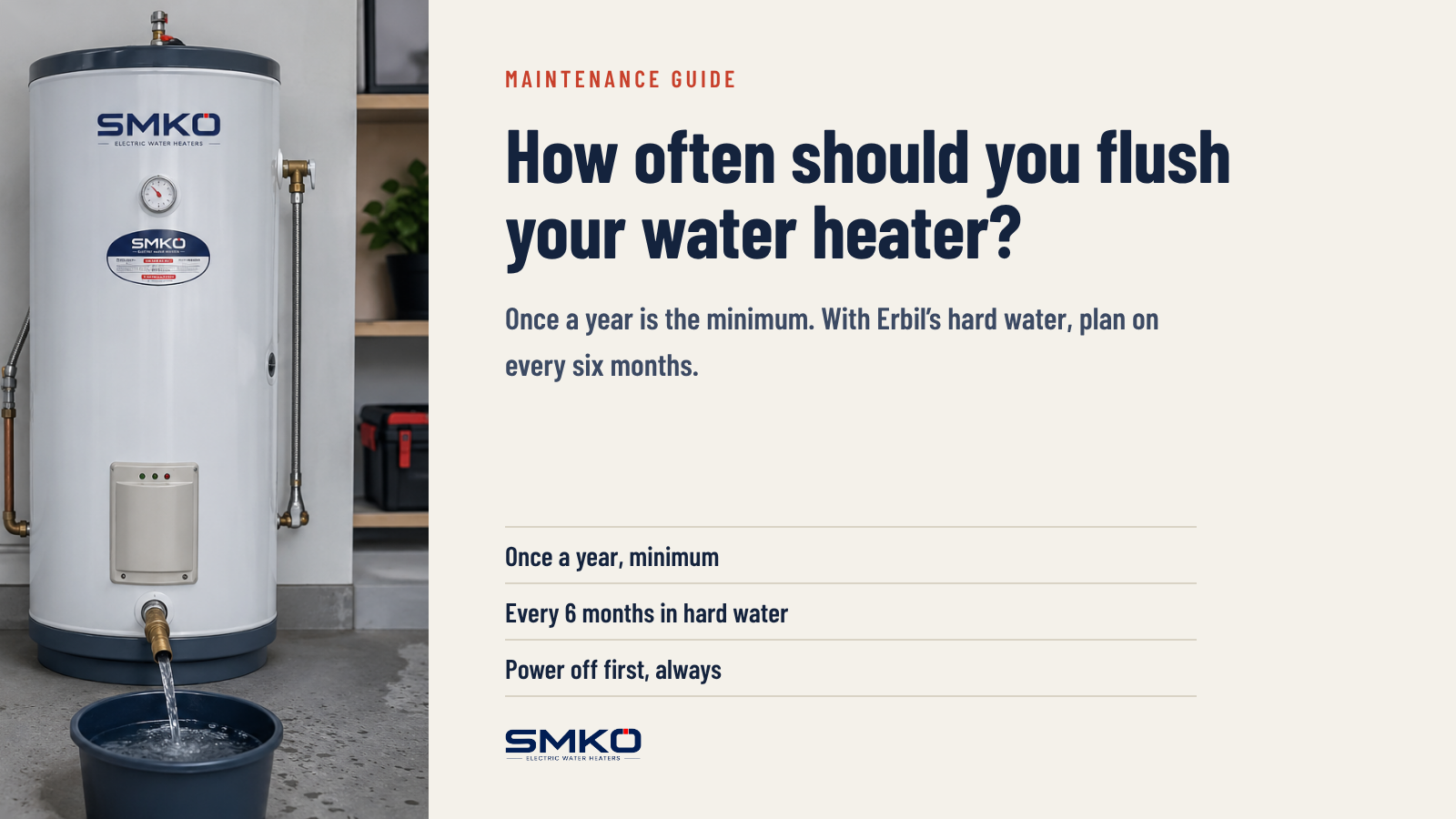
That is what the big manufacturers say too. Rheem recommends once a year, and every six months for hard water. A. O. Smith says most tank heaters need flushing at least once a year and that hard-water areas may need it more often.
Why flush at all?
Tap water carries dissolved minerals, mostly calcium and magnesium. When water is heated, some of those minerals come out of the water and settle at the bottom of the tank as a hard, chalky layer. That layer is sediment.
A little is harmless. A lot causes real trouble:
Slower, weaker heating. The sediment sits between the heat and the water, so the heater works harder for the same result.
Noise. Rumbling or popping sounds are often water trapped under the scale and boiling.
Shorter element life. In an electric heater, scale can bury the lower heating element and make it burn out early.
Higher bills. More running time means more electricity.
How hard is the water here?
Hardness is measured in mg of calcium carbonate per litre (mg CaCO₃/L). On the commonly used scale, 121 to 180 is "hard" and above 180 is "very hard".
Published studies of water in the Erbil area give a sense of the range:
Artesian wells in the Shaqlawa, Harir and Permam area measured 160 to 560 mg CaCO₃/L.
Samples across the Ifraz water treatment plants in Erbil measured 128 to 308 mg CaCO₃/L.
So a lot of Erbil water sits in the hard to very hard range. Two honest caveats: these studies are a few years old, and your own number depends on whether you use well water or the network, and on your neighbourhood. If you want to know exactly, a cheap hardness test strip will tell you.
How often should you flush?
Your situation Flush every
Soft or treated water (softener fitted) 12 months
Normal tap water 12 months, check the drain water each time
Hard water, or well water 6 months
Very hard water, no softener, heavy daily use 3 to 6 months, and look at what comes out
When in doubt, start at six months. Open the drain valve and look at the first litre. If the water is clear, you can stretch the interval. If it is cloudy, gritty or brown, keep it short.
Signs your tank needs attention now
Rumbling, popping or crackling from the tank
Cloudy, rusty or gritty hot water
Hot water runs out faster than it used to
The water takes longer to heat up
Your electricity bill creeps up and nothing else changed
How to flush an electric water heater
Set aside about an hour, plus time for the tank to cool. You need a garden hose and a bucket or a drain you can reach.
Safety first
Switch off the power at the breaker, not only the thermostat.
Never switch the power back on until the tank is completely full. A heating element running without water burns out in seconds.
The water inside can be very hot. Let it cool for an hour or two, or run a hot tap for a few minutes first, and wear gloves.
Keep children and pets away from the hose and the drain area.
Step by step
Power off at the breaker.
Close the cold water inlet valve on top of the heater.
Wait for the water to cool, or run a hot tap for a few minutes to use up some of the hottest water.
Connect a hose to the drain valve at the bottom and run the other end outdoors or to a floor drain, away from the walls.
Open a hot tap somewhere in the house. This lets air in so the tank drains properly.
Open the drain valve and let the tank empty. Watch what comes out.
Rinse. With the drain still open, open the cold inlet for about 15 seconds, let it drain, and repeat a few times until the water runs clear.
Close the drain valve and take the hose off.
Refill. Open the cold inlet and keep the hot tap open until water flows out steadily with no air spitting. That tells you the tank is full.
Close the hot tap, check around the drain valve for drips, and only then switch the power back on.
Always check your heater's manual first. The details differ between models.
While you are at it, two quick checks
Relief valve. This is your safety valve against too much pressure or heat. Once a year, lift its lever briefly. Water should come out and stop when you let go. If nothing comes out, or it keeps dripping, have it replaced.
Anode rod (if your model has one). It is a sacrificial rod that corrodes instead of the tank. A. O. Smith suggests looking at it once a year and replacing it when the core wire is exposed.
When to call a professional
The drain valve will not open, or it leaks
Nothing comes out when you open the drain
You see heavy rust around the fittings
The relief valve drips all the time
The heater is 8 to 12 years old or more and has never been serviced
Quick recap
Flush once a year, or every six months in hard water.
Power off before you start and never power on before the tank is full.
Look at the first litre from the drain. It tells you how often to do it.
Test the relief valve and check the anode rod while you are there.
Have a question about your SMKO heater? Call 0770 281 22 22 or visit smkoiraq.com.
This guide is general advice. Your SMKO manual and a qualified electrician or plumber always come first.
Sources
How Often To Flush Your Water Heater (And How To Do It), Rheem
Water Heater Maintenance, A. O. Smith
How to flush a water heater, Direct Energy
Water Heater Flushing, Great Lakes Water Authority
Assessment of Ground Water Quality for Drinking Purpose in the Shaqlawa Area, Erbil-KRI, Zanco Journal of Pure and Applied Sciences
Evaluation of Ifraz Water Treatment Plants in Erbil City, Iraq
Comments
Share your thoughts on this article. No account or email required.
No comments yet — be the first to share your thoughts.